

Axtra3D Lumia X1: HPS Resin Printing for Dental Labs
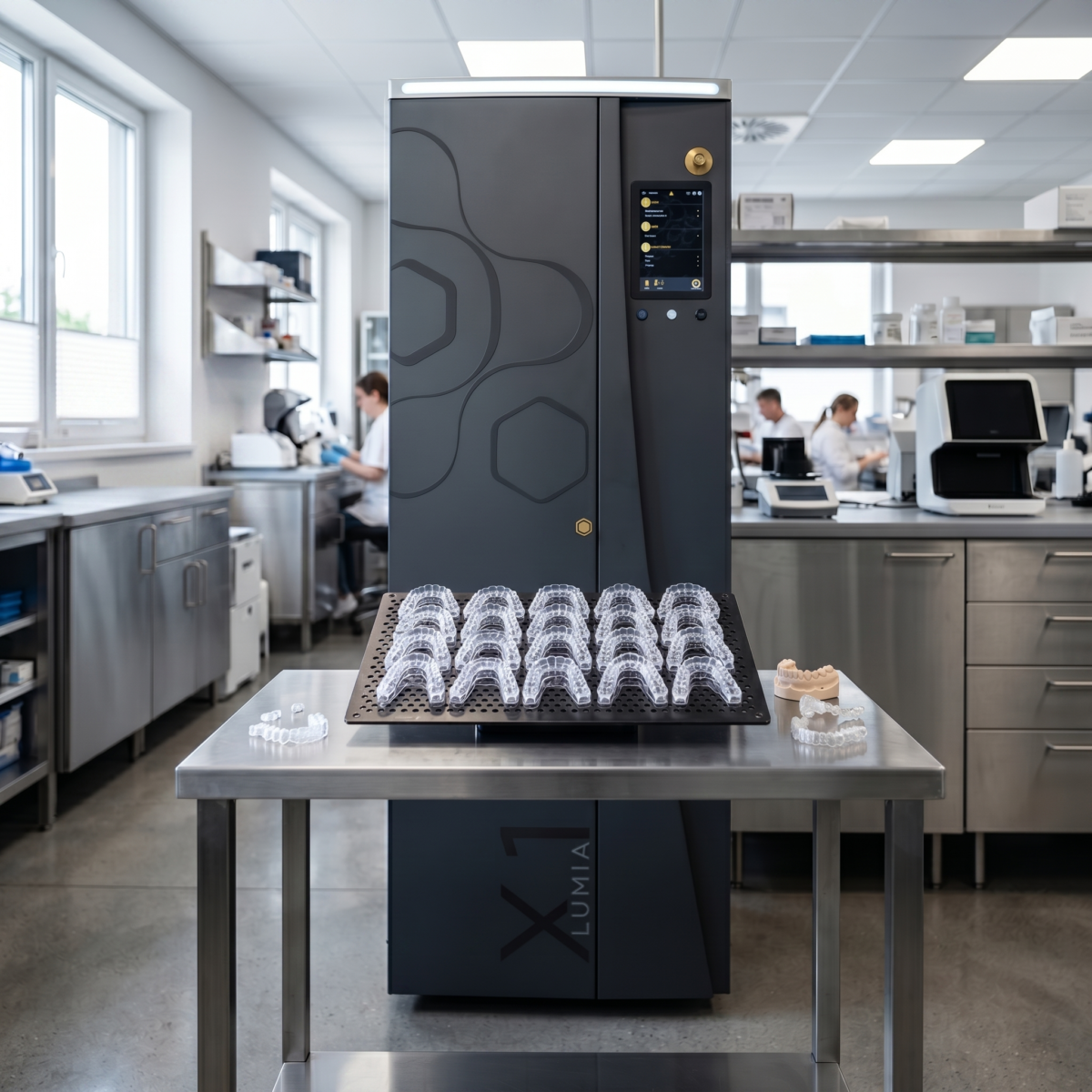
The Axtra3D Lumia X1 is a production-grade resin 3D printer that uses Hybrid PhotoSynthesis (HPS) to combine a laser and 4K DLP projector in a single imaging pass. It delivers 2-20x throughput over conventional SLA, DLP, and LCD systems, supports a 9.8 x 5.5 x 19.6 inch build volume, and prints validated dental resins from NextDent, Pro3dure, and Keystone Industries. Dental labs using it report up to 100% increases in daily output and 50% reductions in cost per part. It’s now available through Dynamism.
For production-focused dental labs, the resin printing trilemma has been a persistent constraint: optimize for speed and sacrifice detail, prioritize surface finish and watch throughput stall, chase accuracy and accept longer cycle times. DLP systems offer speed but struggle with fine features. SLA lasers deliver precision but process serially. LCD platforms provide accessibility but compromise on surface quality and consistency.
The Axtra3D Lumia X1, now available through Dynamism, addresses this directly. Its Hybrid PhotoSynthesis (HPS) technology integrates a laser and 4K DLP projector into a single imaging pass, eliminating the need to choose between competing priorities. Early adopters in dental production report tangible results: near-doubling of daily output, 50% reductions in cost per model, and surface quality that reduces or eliminates manual finishing.
How does Hybrid PhotoSynthesis work?
HPS divides the curing task between two light sources that work simultaneously on each layer. The DLP projector rapidly cures large internal volumes. A laser exposes the same layer to trace external geometries and fine details. Both systems work on the same layer in a single pass, with no sequential processing and no switching between modes.
The division of labor is precise. The DLP handles bulk polymerization where speed matters most. The laser delivers focused energy where resolution and edge definition are critical: marginal fit lines on surgical guides, contact surfaces on aligner models, fine anatomical detail on denture bases.
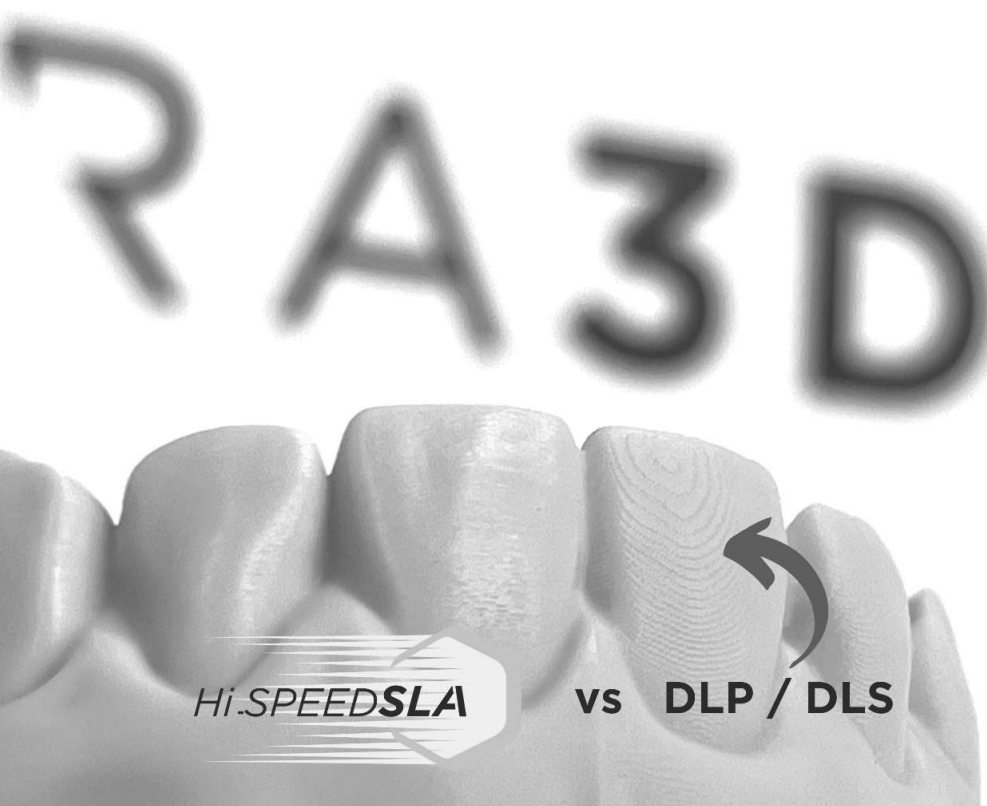
The result is a print that exhibits the surface finish and dimensional accuracy of laser-based systems with cycle times closer to DLP platforms. In comparative testing documented by Axtra3D, a dental arch printed on a DLP-only system shows visible layer lines and surface texture variation. The same geometry printed on the Lumia X1 with HPS demonstrates uniform surface finish across both internal and external features.
For production managers, this means fewer post-processing steps. Splints and nightguards require significantly less manual sanding and polishing to meet patient comfort standards. TeamZiereis, a German dental lab, reported significant surface quality improvements on splints compared to their previous technology, alongside a roughly 100% increase in daily output:
“We are able to improve the surface quality of splints significantly, compared to our current technology. Overall, we can increase our daily output by almost 100%.”
— Ralph Ziereis, CEO, TeamZiereis
What is TruLayer, and why does it matter?
TruLayer is the Lumia X1’s layer separation and alignment system. It addresses two failure modes common in high-speed resin printing: separation delays and layer thickness variation. Throughput gains mean little if consistency suffers, and TruLayer is what keeps the Lumia X1’s speed from degrading print quality.
TruLayer Separation rapidly detaches each layer from the build surface, eliminating the hydrostatic forces and slow vertical lift required by traditional DLP and LCD printers. Pulling the cured layer away from the vat film is a process that scales with print cross-section and introduces delay. TruLayer eliminates this bottleneck, enabling faster z-axis movement without risking layer delamination or print failure.
TruLayer Adaption maintains consistent resin thickness across the entire build plate by dynamically adjusting the glass plate position during the print. This maintains consistent imaging across the full build area and prevents the dimensional drift that can occur in tall parts like full-arch models or stacked aligner sets.
The Lumia X1 also uses a dual z-axis system, moving both sides of the build plate independently. Single-axis configurations introduce pivoting as the platform lifts, creating asymmetric force distribution and positional error. With dual z-control, each layer stacks with micron-level precision, which is critical for parts like surgical guides, where small positional errors compound across the print and affect downstream clinical fit.
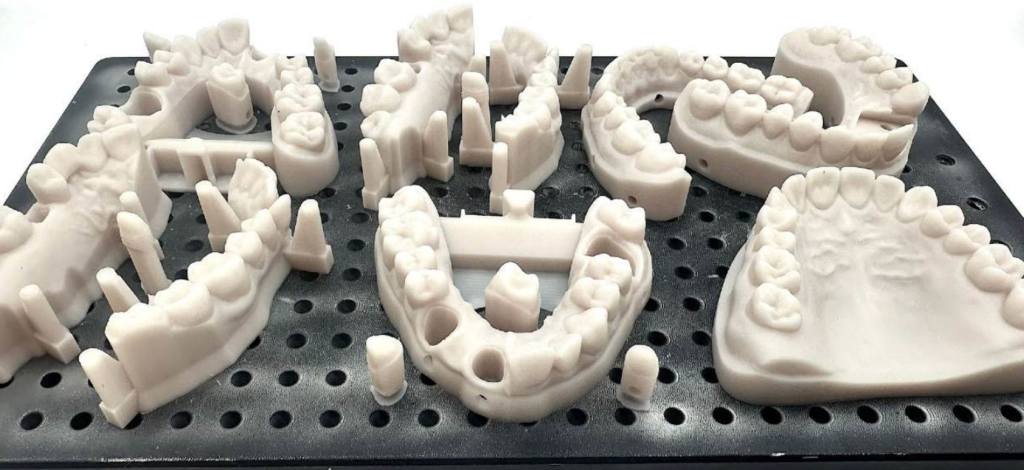
Prinoa Dental, a digital manufacturing center in Germany, integrated the Lumia X1 into their production workflow and reported multi-fold increases in 3D printing capacity:
“Thanks to the extremely fast HPS process, we were able to increase our 3D printing capacities many times over, offer our customers completely new materials, and thus take our innovative manufacturing concept a further step forward.”
— Marcus Klab, CEO, Prinoa Dental
How much throughput improvement does the Lumia X1 deliver?
Throughput improvements range from 2x to 20x depending on part geometry and the comparison baseline. The wider end of that range applies to conventional SLA, DLP, and LCD platforms, where serial laser tracing or slow separation cycles dominate cycle time. Against newer Digital Light Synthesis (DLS) systems, which are already a faster baseline, dental labs have measured productivity gains up to 40%. The takeaway: HPS delivers meaningful gains regardless of the comparison point, with the largest deltas against legacy technology.
Cost per model drops accordingly. Prinoa reports a 50% reduction in cost per part, driven by faster cycle times, reduced labor for post-processing, and higher build plate utilization. For labs running three shifts or managing volume spikes, this changes capacity planning.
What materials and applications does the Lumia X1 support?
The Lumia X1 supports a broad material library developed in collaboration with NextDent, Pro3dure, and Keystone Industries. This includes biocompatible resins for intraoral use, rigid materials for surgical guides, and tough formulations for splints and dentures.
On the dental side, this covers:
- Dental models for restorative and orthodontic planning
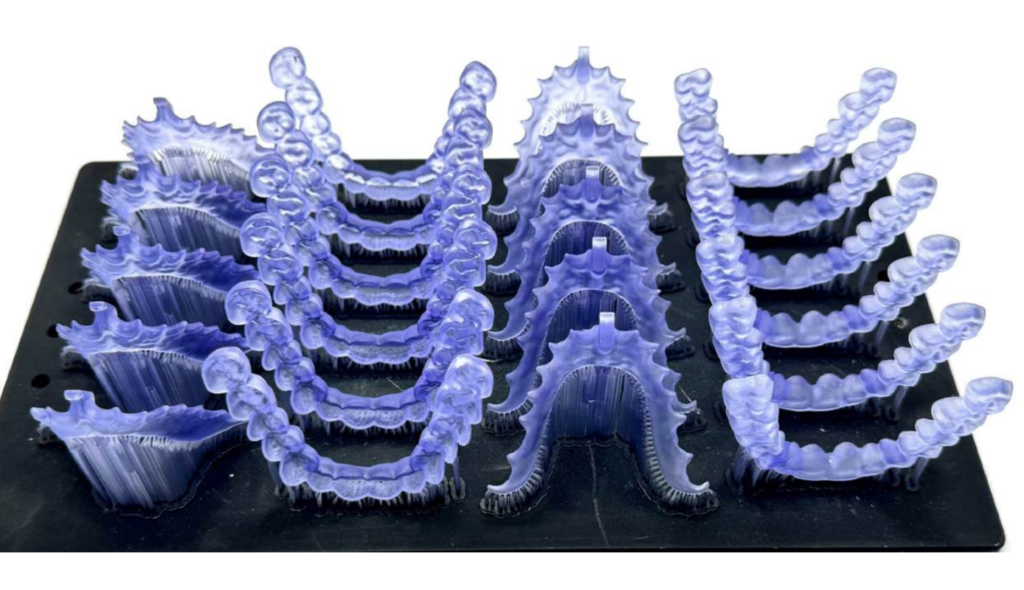
- Clear aligners and aligner production models
- Splints and nightguards
- Surgical guides for implant placement
- Denture bases
Beyond dental, the platform handles concept injection molding and ceramic mold inserts, electronic connectors, and functional prototypes for low-volume production. Labs can switch between applications without switching printers, which reduces capital expenditure and floor space requirements. This versatility matters for labs diversifying revenue streams or contract manufacturers serving multiple verticals.
What does the glass-like surface finish actually mean for production?
The glass-like surface finish HPS produces translates to specific production benefits. For clear aligner models, this means less manual polishing to achieve optical clarity. For intraoral applications like denture bases and splints, smoother surfaces matter for long-term patient comfort.
TeamZiereis specifically highlighted surface quality improvements on splints, a notoriously challenging application where patient comfort depends on smooth palatal contact and even occlusal surfaces. Eliminating finishing steps on these parts compounds the throughput advantage: faster printing and faster post-processing.
When does consolidating onto a Lumia X1 make sense?
For labs currently running multiple DLP or SLA printers to manage volume, the Lumia X1’s throughput profile makes consolidation feasible. A single HPS platform can absorb the workload of several legacy units, freeing floor space, reducing maintenance overhead, and simplifying material handling. For operations evaluating in-house production versus outsourcing, the cost-per-part economics shift the threshold at which insourcing becomes the better decision.
Lumia X1 specifications
| Parameter | Value |
|---|---|
| Model | Hi-SPEED SLA Lumia X1 |
| Separation technology | TruLayer Adaptive Separation |
| Max print volume | 9.8 x 5.5 x 19.6 in (249 x 140 x 499 mm) |
| XY resolution | Up to 50 μm |
| Z-axis resolution | Dual Z-axis, up to 5 μm step |
| Layer thickness | 25 to 200 μm and above (material dependent) |
| Light source | HPS Simultaneous Laser + 4K DLP imaging |
| Materials | 405 nm resins |
| File formats | STL, 3MF, AMF, CLI, OBJ, Polygon, ExoCAD, Slice, SLA |
| Machine dimensions | 31.5 x 31.5 x 70.9 in (80 x 80 x 180 cm) |
| Regulatory | CE / FDA / RoHS, NRTL ready |
| Software | AxtraVolume Software (included), Open System available |
Frequently asked questions
The Lumia X1 is manufactured by Axtra3D, an additive manufacturing company headquartered in Charlotte, North Carolina, with European operations in Vicenza, Italy. Dynamism is an authorized reseller.
Dental laboratories are the primary adopters, but the printer also serves concept injection molding, electronics, and functional prototyping for industrial production.
The platform runs validated 405 nm resins from NextDent, Pro3dure, Keystone Industries, and other Axtra3D ecosystem partners. The Axtra OpenAccess configuration allows experimentation with additional materials.
Yes. The printer is CE, FDA, and RoHS compliant and NRTL-ready for production environments including dental and medical labs.
Against conventional SLA, DLP, and LCD systems, it offers 2-20x throughput gains and a glass-like surface finish in a single platform. Against faster DLS systems, dental labs have measured up to 40% productivity gains. The dual imaging approach (laser plus DLP) is the key differentiator. Learn how Dynamism supports dental 3D printing workflows across labs and clinical production environments.
Dynamism is an authorized reseller. Request a quote on the Lumia X1 product page or contact a Dynamism specialist for sample parts, material recommendations, and ROI calculations.
Next steps with Dynamism
Dynamism provides the technical support, material sourcing, and integration planning required to deploy the Lumia X1 in production environments. Whether you’re replacing aging equipment, expanding capacity, or evaluating your first resin platform, we’ll help you model throughput impact, material compatibility, and workflow integration specific to your case mix.
We’ll provide sample parts, material recommendations, and ROI projections based on your current volume and case types.