Categories
Scaling a University Makerspace

 Leading Tech Since 1997

If you’ve ever been working closely on a manufacturing production line, you know how much time it can take to research and implement the perfect part. A company that understands that problem very intimately is Shining 3D.
Shining 3D is one of the industries most innovative companies in the 3D printing industry that provides its users with technology that makes your production smooth and seamless. The company knows that there are a multitude of user-bases that have specific needs, so they are designed to work for all purposes.
Their scanners allow users to better inspect objects for a more detailed breakdown, and encourage them to completely reverse engineer objects for future use.

Choosing the right 3D scanner can be complicated, especially if you have no experience with the technology. So, take a look at our extensive handheld scanner guide to gain some key insight onto what scanners might work for you.
The best way to tell if a product actually works is to see how it performs in action. So, take a look at some automotive user case studies from Shining 3D customers.
When the people you transport in your vehicles are in the midst of a medical emergency, you want to make sure that it’s ready for anything that might happen. With that ideology in mind, System Strobel, a commercial vehicle manufacturer specializing in ambulance, patient transport and emergency vehicles, makes it happen.
Using the power of the Einscan HX, the company was able to capture a high resolution 3D scan of an Audi A6’s trunk. This helped them to completely customize the rear of the vehicle to store crucial medical equipment in a safe and secure environment.
Have you ever been so frustrated by your current vehicle that you decide to take matters into your own hands? Well, Bryan Fuller of Fuller Auto did exactly that.
Using an EinScan Pro 2X Plus Multifunctional Handheld 3D Scanner, he was able to add some key after-market parts like a PWR Radiator to fully customize his riding experience. Instead of using the old-school conventional ways of measuring and designing, the Einscan allows users to get the best results and provide the most accurate and efficient experience.
How? By utilizing a three step process that emphasizes data acquisition, their point cloud system, and their final meshing technology.


From prototypes and parts, to producing best-sellers in the automotive industry, 3D printing has enabled cars to truly evolve for the better. No longer is the 3D printer considered a piece of niche technology, but it has resulted in major success for a litany of car brands.
Which car brands have added value, cut costs, or even expedited their manufacturing processes with 3D printing? Take a look at just some of them below!

As the company that introduced the world to the car and the assembly line, it’s only right that Ford is still at the forefront of pushing the boundaries of technology. For years, Ford has utilized what 3D printing has to offer, especially in their manufacturing process.
Even more exciting, though, is that Ford is embracing change by offering its customers the ability to modify their vehicles post-purchase with 3D printed add-ons. More specifically, Ford’s Maverick Pickup is letting users be creative with the FITS system; “a series of slots at the rear of the center console and the under-seat storage bins designed to use with accessories.”
Interested in specific Case Studies from our trusted 3D Printer Makers? Take a look at one from Ultimaker, Desktop Metal, and BigRep.
The Toyota Corolla is known for its dependability and reliability. Consequently, the Japanese automotive giants turned to 3D printers to get their cars to market sooner.
Ricoh 3D, a 3D printing industry service provider, enlisted their workshop to print and manufacture prototypes for Toyota.
Why? So they could get a better idea on how parts would print, react to conditions, and overall impact their final product.


What do you get when you mix Germany’s top automotive and automation companies? A perfect marriage of innovation and an increase of production. Both Volkswagen and Siemens have teamed up to implement adhesive in their binder jetting process.
Adoption of this world-class technology is propelling them to move forward and actually make this form of production suitable for many years to come. This is hardly a surprise to those that have taken notice of Volkswagen’s process the past few years.
Why? Many of our 3D maker partners have worked closely with the German giant as of late, specifically Ultimaker in their 2017 Case Study.
When you think of Chevrolet, what do you think of? The Corvette? The Camaro? The Chevy Silverado? Well, we do too. Not just because they are industry staples, but because those models effectively use the power of 3D printing.
The Racing Team at Chevy, employing 3D printing technology, have equipped their race cars , specifically the Corvette C8.R, INDYCAR, Silverado race truck and NASCAR Camaro, with 3D printed parts.
This has successfully allowed themselves to not only support over 80,000 miles of production, but to take home a whole trophy case worth of awards in the process. Suffice it to say, 3D printing has done its job, and then some.


Debuting as a concept car in 2016 and finally hitting the market in 2019, the Kia Telluride was able to first be envisioned through 3D printing. In a 2016 press release, the company announced a new model, and was able to display their concept at the 2016 North American International Auto Show.
Their final model features a “steering wheel, dash, and even door panels” that were produced with 3D printing technology.
This may not seem like that big of a deal to some, but their implementation of cutting-edge technology has proved to be very successful for the Telluride, propelling the model to be a best-seller in the United States.
In an effort to embrace new technologies that advance the market-share of electric vehicles and to help combat climate change, Hyundai has established a key relationship with Nanyang Technological University, Singapore to further delve into the true potential of 3D printing.
They aim to do this by establishing top-notch production facilities dedicated to improving their additive manufacturing and giving customers some truly unique options. With customization in mind, Hyundai believes that they will be able to offer their cars to customers on a more personal level, adding specifically tailored functionality.
Additionally, 3D printing is pushing them to cut their time spent on the design cycle drastically. This enables them to reap the reward of huge cost savings which can be reinvested into the company’s daily operations.


It’s no secret that companies embracing 3D printers are often looking to improve their manufacturing efforts. Unsurprisingly, that’s exactly what Fiat Chrysler is aiming to do.
The Fraunhofer Research Institution for Additive Manufacturing Technologies’ (IAPT) research team along with engineers from Fiat Chrysler teamed up to embrace innovation through 3D printing, creating “a 3D printed suspension part for one of its sports cars.”
Even more exciting is that the Italian-American corporation features high-powdered and prestigious brands like Maserati, Lancia, and Alfa Romeo. We’re certainly excited to see where the brand evolves with their increasingly robust use of 3D printing.
We don’t know about you, but when we think of a luxurious, modern, and sleek car that’s just begging to be driven, we think of the BMW i8 Roadster. BMW, a leading pioneer in the automotive industry, has constantly been at the forefront of car production.
For over 28 years, the company has been researching and perfecting the use of additive manufacturing. This has not only enabled them to make better looking vehicles, but they have had exceptional measurable results which have produced parts that are lighter and sturdier.
As time progresses, we anticipate BMW to continue leading the way on utilizing 3D printing in the automotive industry, whether it’s in their most premiere models, or along the assembly line.


When Audi needed a quick solution to replacing and implementing parts in the assembly process, they looked to their team of engineers, who, in turn, looked to their collection of 3D printers.
The printers in their Audi R8 factory in the Böllinger Höfe allow them to custom build parts on a case-by-case basis, and give their engineers immediate feedback on how they will fit and work in their vehicles.
Using CAD technology, they were able to print crucial parts that place key sensors in their vehicles. This has made their production process incredibly seamless and helps to build faster and better.
When you stumble upon a bump in the road, you better have some confidence in your suspension. In order to increase their performance, British Luxury Sports Car Icon Aston Martin turned to the team at Domin to embrace 3D printing “for the development of a “world-leading” suspension system.”
Aston Martin’s end goal is to achieve implementation of their 3D printed suspension system in their final products through rigorous testing and prototyping in the production process.
From the outside looking in, we have the utmost confidence that the car brand will have success in this venture, considering this is far from the first time they have deployed additive manufacturing.


When the Italian supercar brand takes on a new technology to produce some of the most stunning vehicles the world has to offer, you should take notice. Their Sián Coupé and Roadster feature modern design through the capabilities of 3D printing, namely in their air ventilation system.
Although they are using the technology in relatively small capacities, we anticipate that they, and other luxury brands, will continue to adopt it in the future. Why? Because additive manufacturing is continually growing and proving its worth among others.
In our experience, all of our customers all come from unique backgrounds. Some printers don’t offer the capabilities that fit your needs quite like you need them to. Do you have any questions about our selection of products, potential savings opportunities, or anything in between? Fill out the contact form below and we will be in touch shortly!


Year after year, schools and their teachers search for the best educational techniques to bring excitement and learning to the classroom. You will achieve both goals with the hands-on learning experience of 3D printing.
Students benefit in many ways with the introduction of 3D printing to their curriculum. How?
Textbook based readings and standard homework assignments have always been a long-term strategy for learning. But, the on-screen to real-world nature of 3D printing truly sparks the engagement and creativity of students.
At least as far as Onfim in the 13th Century, students have strived to be creative in the classroom, either through their assigned homework and projects, or simply by doodling at their desk.
Bringing in the engaging technology of 3D printing allows students to exercise their creativity. Designing on their own and seeing it come to life can nurture that inherent creative spirit and push them to continue that mindset.
Studies have shown a high correlation between classroom 3D printing use and academic achievement.
A 2018 study found that students that worked with 3D printing were able to more quickly and decisively answer questions on medical examinations, which was correlated with higher test scores.
Spatial Learning and its benefits are widely accepted. Utilizing the advanced technology of 3D printing is an excellent way to practice this learning technique. It helps to engage with your students and increases their capacity to better understand their surroundings.
3D printing benefits students in the short-term, and it helps ensure that they will be able to retain those skills as they grow older.

Students that interact and actively use 3D printing technology gain valuable technological skills, but they will also derive other measurable benefits. By actively using new technology like 3D printers in group projects and presentations, students will increase social and communication skills.
A study, conducted at Texas A&M University, echoed that sentiment, stating that working with and designing for 3D printing projects has “a positive influence on student’s motivation, interests, mathematic skills, and real-life skills.”
As STEAM learning becomes more adopted, 3D printers have raced to the forefront of education. This approach has shown benefits in multiple ways, namely through the crucial impact it has had on girls.
An initiative demonstrating this remarkable impact is MakerGirl from the University of Illinois at Urbana-Champaign. This program has shown great efficacy by providing workshops and educational material to girls age 7 and up.

When you take a look back at the technological advancements of the past century, it is truly incredible how much innovation has occurred. It is not essential for students to have access to 3D printers.
For an entire nation, its workers, and its students, having access to leading technology bestows a “first-mover” advantage that lasts for decades. Implementing 3D printing in your school can help to provide that critical experience, giving your students true opportunity in the economy of the 2020s.
To kick off 2022, Dynamism created a brand-new EDU Purchasing Guide for our Nation’s educators to get a better idea of which items might help their classroom. Take a look at our guide by filling out the form below!

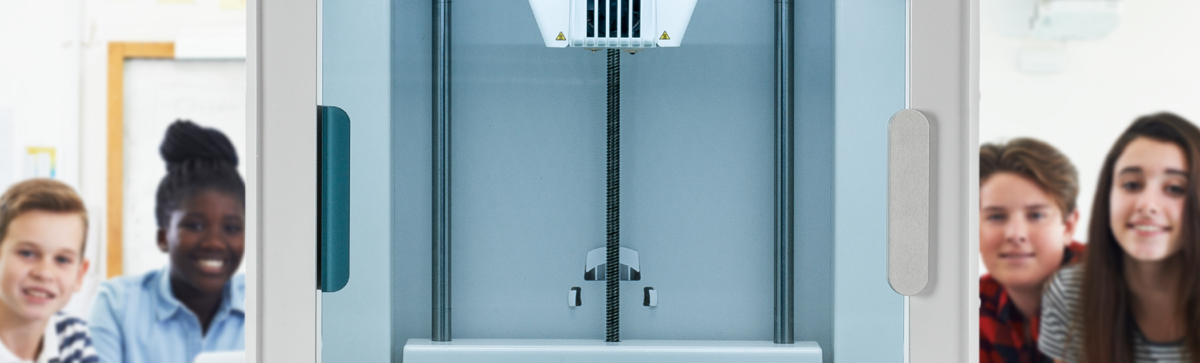
We’re often asked if the kit-like 3D printers, usually marketed as a cool toy for consumers, and costing less than professional 3D printers, would be sufficient for a classroom. While these printers are okay for occasional printing in your garage, they don’t stand up to the rigor of daily use (whether by kids or adults), nor do they produce reliable and repeatable results.
Investing in 3D printers designed for education will provide you the best long term return on investment, and reliably produce the best educational outcomes. The cheaper consumer-focused 3D printer is enticing, but they are typically only used for a few months before most realize they need a more robust tool.
Dynamism only sells professional-grade printers that will endure daily use, are easy to maintain, and generally modular–so if repairs are needed the vast majority are simple part swaps. Our printers are designed and manufactured for the heavy, everyday use in the educational 3D printer lab, classroom, factory floor, or engineer’s daily use. These are a larger upfront investment than consumer-focused printers, but a lower cost of long-term ownership, and immeasurably better ownership experience due to their reliability and accuracy.
In many cases we, working with our maker partners, can offer special Educator-only pricing. Fill out the form below to view your savings.
3D printing in education comes in three easy pieces: 3D printers, the consumable that is used for printing (filament or resin), and software.

There are many options when it comes to top tier 3D printers for school, but we have some top recommendations. For schools with the most budget flexibility, we recommend Ultimaker. Headquartered in the Netherlands, Ultimaker produces a beautiful quality and well manufactured 3D printer that is sophisticated, yet easy to use. They are simple to set up and run reliably.
As with any mechanical tool, occasional maintenance is needed. Ultimaker’s design makes this easy. And, our Warranty Plans can protect you against any unexpected cost for years to come.
Ultimaker’s best-seller is the Ultimaker S5. This printer also features Ultimaker’s largest potential print volume.
Be sure to check out the Ultimaker S5 Pro Bundle, which includes air manager (with filtration), material station (for easy changing of filament colors or types), and all the necessary software to get your curriculum running.
Ultimaker S3 is very similar to the Ultimaker S5, but with a smaller potential printing area. It also uses less space on a tabletop. So, if space is a concern, or if you want more printers in a given budget, the Ultimaker S3 is an excellent option.
Out of the box, the Ultimaker 2+ Connect may be our most easy printer to start working with. The biggest difference between the 2+ and the S5/S3 is that it is a single extraction printer. This means that your prints will only be made with one filament type and may be less complex, but that can be a benefit depending on your classroom’s needs.
If you’d like even more functionality, we offer the Ultimaker 2+ Connect Air Manager Bundle which will help to filtrate your printing process.

Resin or Filament is the substance that your 3D printer uses to create an object. There are many 3D printing materials available, but if you would like to go with an Ultimaker 3D printer, we recommend Dynamism filament, or Ultimaker filament.
An optional add-on for the Ultimaker S5 is the ever-so-useful Material Station. This add-on helps to ensure that your filament is stored in optimal humidity, automatically changes spools when necessary, and is included in the S5 Pro Bundle. Simply put, it’s an elegant solution.

Software can truly enhance your 3D printing experience. Some key programs cut down on time spent printing and materials used for your Software is a critical aspect of the 3D printing experience. Good software will configure your printer to achieve goals faster, and with less use of materials.
A lot of our Ultimaker bundles come with top of the line 3D printing software. Some bundles feature Ultimaker Essentials/Personal Software, but other Ultimaker printers give you eligibility for huge discounts on SmartSlice for Ultimaker Cura.
Ultimaker Cura is the world’s most popular 3D printing software. As a simple to use slicing software, Cura integrates smoothly with any workflow through their Marketplace plugins. With the needs of both beginners and engineers, Cura will make the most of your Ultimaker with a more speedy and reliable printing process.
SmartSlice is a state of the art software designed for Ultimaker Cura that helps you optimize prints efficiently. By improving build instructions to the 3D printer, SmartSlice helps to cut down on the amount of time you spend printing and the amount of filament you use during your print, resulting in time and cost savings.
As you can see, there are many ways to gain efficiency with professional 3D printers. Although they are more expensive up front, they will save on overhead costs and give you back some much needed time for other tasks. Additionally, there are a plethora of materials, parts, and 3D printing software to limit waste and get more out of a given budget.
Whether you’re ready to start now, or you still have questions, check out our catalog of printers, materials, parts, and other useful tools. Or, if you want a more personal touch, reach out directly to one of our Product Experts at 1-800-711-6277 or sales@dynamism.com.
To kick off 2022, Dynamism created a brand-new EDU Purchasing Guide for our Nation’s educators to get a better idea of which items might help their classroom. Take a look at our guide by filling out the form below!

3D printing has exploded in importance in recent years, and now schools are starting to embrace the revolutionary technology. Still, 3D printing can remain a challenging technology to embrace for those without previous experience.
So, let our team at Dynamism walk you through the process, and we’ll start with answering some of the most common questions from educators.
There are some key pieces of information that you need to know before you can start printing in your classroom. Take a look at our checklist below!
First is choosing the right 3D printer. Choosing the right 3D printer will have the largest impact on the rest of your experience. We can offer expert, unbiased, and detailed advice. As a start, we have a few recommendations below.
Which 3D printer will benefit my classroom?
Deciding which 3D printers to bring to your classroom can be confusing. Here are some tips from our extensive experience working with educators.
For classrooms filled with eager kids, having printing bandwidth, easy accessible storage, and detailed plans to jump-start your learning are your keys to running a successful program. See which of our options is for you with our recommendations below.

Looking to get started with a fast and simple-to-use 3D Printer that comes with numerous bells and whistles? Our MakerBot Sketch Classroom Bundle comes with two printers, an abundance of extra filament, and over 600 educational lesson plans to keep you covered through your entire school year and beyond. Order this bundle to get a great plug-and-play, straight out of the box, experience.

Another excellent option for the classroom is our Dremel DigiLab 3D45 Education Package. It includes the Dremel DigiLab 3D45 printer, along with extra filament, 30 lesson plans for hands-on experience, and the opportunity to acquire 4 hours of Online Professional Development Credit through ISTE. To learn how to earn your 4 hours, please visit Dremel’s ISTE Certified PD Certificate Access Walkthrough.
For classrooms with students looking to expand their knowledge and get a little more serious with 3D Printing capabilities, here are excellent options.

If you’re ready to bring 3D printing technology used by thousands of professional engineers to your classroom, try multi-color dual-head extrusion with the Ultimaker S5. Here, students get hands-on and real-world experience creating industrial-quality parts using Fused Filament Fabrication (FFF) printing.
Additionally, our bundle provides you with a seamless printing experience, with the inclusion of the Air Manager, Material Station, and professional grade software.
Generally, the Ultimaker Series is an excellent option for new and experienced users alike. Take a look at our catalog of Ultimakers to see what might fit your needs.

Many of our Dynamism printer packages come with useful tools, and the Formlabs Form 3+ Complete Package is no exception. The Resin Tank, Build Platform, Finish Kit, and other add-ons will provide you with extraordinary value to get the most out of your printer. To view our complete selection of Formlabs printers, please click here.
Do you have some more questions?
If you aren’t quite sure what products would be best for your classroom, please check out our buying guide for teachers, reach out to one of our product experts by phone at 1-800-711-6277, email us at sales@dynamism.com, or simply enter your information below and we will get back to you shortly.
Think of filament or resin as analogous to ink in traditional printers. When printing, you’ll need the physical component that is transformed into your model. Generally speaking, filament arrives as a long thread on a spool, while resin is a liquid hardened in the 3D printing process.
Printer brands that use filament include MakerBot and Ultimaker, and printer brands that use resin include Formlabs and Nexa3D.
Having the right software for your 3D printer makes operating it so much easier. We recommend utilizing PrintLab’s Classroom Software. PrintLab’s software can serve the entire classroom or just the teacher. This software gives you everything needed to get your lesson plan rolling.
In short, PrintLab Classroom provides you with top-of-the-line teacher training, lesson plans, and certifications.
3D scanners are not a classroom necessity, but they’re a remarkable luxury.
Using pinpoint laser technology, these scanners create truly remarkable 3D models of real-world objects. Scan any object you want to use in your project, and print it straight away. To view our handheld 3D scanner guide, please click here.
Whether you’re a beginner or a veteran, 3D printing can be challenging. At Dynamism, we pride ourselves on providing you with unparalleled, unlimited, and always free support by toll-free phone, email, or chat.
In addition to unlimited free support, we also offer paid support options that include setup and training by videoconference or on-site, at your location. You can book a session with an expert from our staff to walk you through your product set up, and can even provide step-by-step instructions in real-time on any complications that you may be experiencing.
You can either design your own files to print, or you can utilize online communities to download designs. If you’re looking for creative projects to print, check out some of these links:
To kick off 2022, Dynamism created a brand-new EDU Purchasing Guide for our Nation’s educators to get a better idea of which items might help their classroom. Take a look at our guide by filling out the form below!

If 3D printed parts are intended for food contact items, you‘ll have to consider safety practices and regulations to avoid contact with toxic substances and prevent the buildup of harmful bacteria. Food safe 3D printing is possible and the variety of materials approved as food safe is increasing, but there is a high degree of ambiguity around the workflows and finding the appropriate applicable regulations can be a challenge.
Read on for an introduction to food safety, food safety considerations for 3D printing, and a variety of methods to produce food safe products with common 3D printing processes, including stereolithography (SLA), fused deposition modeling (FDM), and selective laser sintering (SLS).
To begin, it’s important to clarify a few key terms:
Food grading and food safety concern a specific way to ingest parts, called migration. Particles as small as a few nanometers and up to several hundred nanometers may get transferred each time various materials encounter with each other, for example from components of the 3D printer to the 3D printed object, and from the object to the food.
Because migration levels are very low on occasional contact, food grading typically concerns items that are in prolonged contact with food such as containers, straws, utensils, plates, and food molds. Different testing institutions will adhere to different government-imposed risk tolerances and approved substances, which for the US is described by the FDA CFR 21 and for the EU in guidelines 10/2011.
To be considered food safe according to the FDA Food Code, a material has to meet the following requirements:
Any FDA or EU approved material includes not only the raw polymer but also the additives or masterbatch. These might contain components such as plasticizers, impact and heat distortion modifiers, UV-stabilizers, flame retardants, anti-fouling, anti-static, anti-slip, foaming and clarifying agents, anti-oxidants, aromatic nucleators, carbon alloys, phosphorescents, fillers, thickeners, chain extenders, metal deactivators, dyes, and a carrier resin.
A 3D printed part can turn into a petri dish squirming with bacteria within weeks. Even though some materials will survive the dishwasher, so will dangerous bacteria such as E. coli and salmonella that live in the little nooks and crannies. Some toxic molds find favorable growth conditions on several types of plastic and are hard to remove. Neither cleaning with bleach nor microwaving your polymers is an option for eliminating germs.
While bacteria buildup might not be an issue for disposable items, if you’re planning to create a part for long-term use, using a food-safe coating is highly recommended.
The best option to reduce the risk of particle migration and bacteria buildup is by dip coating the 3D printed parts with a food grade epoxy or polyurethane resin, such as Masterbond’s EP42HT-2FG or ArtResin or an FDA approved PTFE (known as Teflon®) to seal their surface.
However, note that coating also doesn’t guarantee food safety for prolonged use as not all of these coatings are dishwasher safe, and they may degrade over time, exposing the original, potentially non-safe surface.
Most 3D printing materials have a low heat deflection temperature (HDT), which means that the 3D printed parts might become brittle and crack, or deform and warp at elevated temperatures. If you’re planning to clean a 3D printed part in a dishwasher, make sure to double check that the material is dishwasher safe and if there are any specific recommendations for washing temperature.
As particles might migrate from components of a 3D printer to 3D printed parts, it is crucial that any components that might come in contact with the 3D printing material or the part are food grade and do not contain or leach harmful chemicals.
This includes taking precautions when using multiple materials, as some materials previously used in the 3D printer might have contained toxic particles and made contact with some components.
Many 3D printing materials are not food safe and might contain toxic chemicals. Only use materials to 3D print parts intended for food contact that are certified for food safety.
As may be expected, the risk of migration is higher if the food is exposed to the 3D printed part for an extended time period. In general, try to limit food contact time and take further precautions for parts that will be in contact with food for longer periods of time.
Think about the reason why you’d like to use 3D printing for a food-contact item. If it’s to create custom shapes and forms, in most cases, there are indirect ways to use 3D printing to create these custom parts, for example with molding. See an example in the next section.
SLA 3D printing uses a laser to cure liquid resin into hardened plastic in a process called photopolymerization, resulting in parts that have the highest resolution and accuracy, the clearest details, and the smoothest surface finish of all plastic 3D printing technologies.
Is resin food safe? The answer is no. Substances may migrate from SLA parts which makes none of the resins and printed parts food safe by default. While some resins for dental and medical applications are certified biocompatible, that doesn’t mean that they’re food safe. These materials are certified for specific applications and should not be used for food contact products.
SLA parts have a smooth surface finish that makes it easier to use coatings to seal their surface and prevent the buildup of bacteria. The factors which affect the ultimate smoothness of a part include resin type, layer thickness, build orientation, mesh triangulation resolution of the 3D model, and the curing profile of the SLA resin. Printed parts require washing and post-curing according to the manufacturer’s instructions before the coating is applied. However, note that coatings don’t guarantee food safety, as the coating may interact with the resin or degrade over time, exposing the original, potentially non-safe surface.
Creating custom molds is a common way to leverage the benefits of SLA 3D printing to produce highly detailed custom parts without having the 3D printing parts come into direct contact with food. While SLA 3D prints aren’t suitable for directly molding foods, SLA 3D printers are perfect tools to create mold negatives, which can be vacuum formed using food safe plastic.

Electroplating is the process of coating parts with metal using an electric current. The process is most commonly used for decorative purposes or to prevent corrosion by creating a durable surface.
SLA parts are ideal for electroplating due to their smooth surface finish. However, as plastics are nonconductive surfaces, SLA 3D prints have to be rendered conductive by coating with graphite, conductive lacquer, electroless plate, or a vaporized coating.
Food safe metal coatings are available, but as the process involves various chemicals, making sure that the workflow is approved for food contact is the developer’s own liability.
SLA 3D printing offers the unique possibility to produce ceramic parts. After 3D printing, parts can be fired in a kiln to burn out the resin and form a true ceramic part that is strong and heat-resistant. With subsequent food safe glazing, the parts will become more hygienic and resistant to most chemicals.
A variety of food-safe glazes are available on the market, but make sure to follow the manufacturer’s instructions in accordance with food safety guidelines.
FDM is a 3D printing process that builds parts by melting and extruding thermoplastic filament, which a print nozzle deposits layer by layer in the build area.
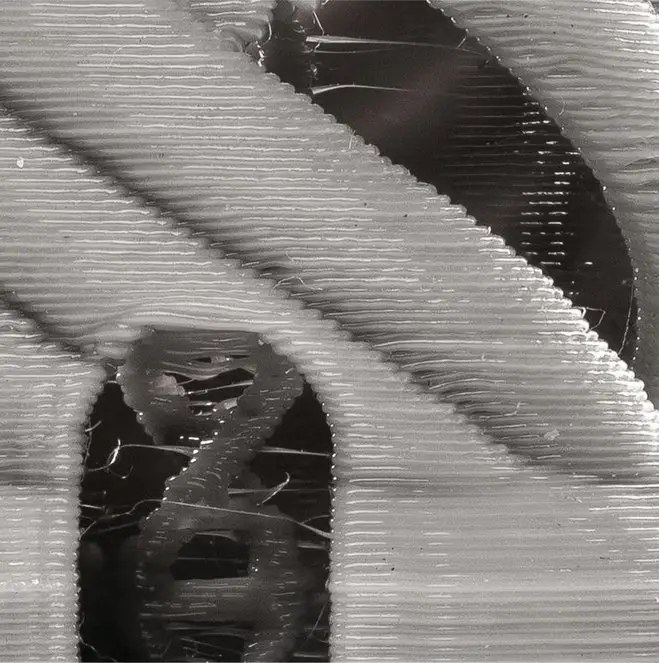
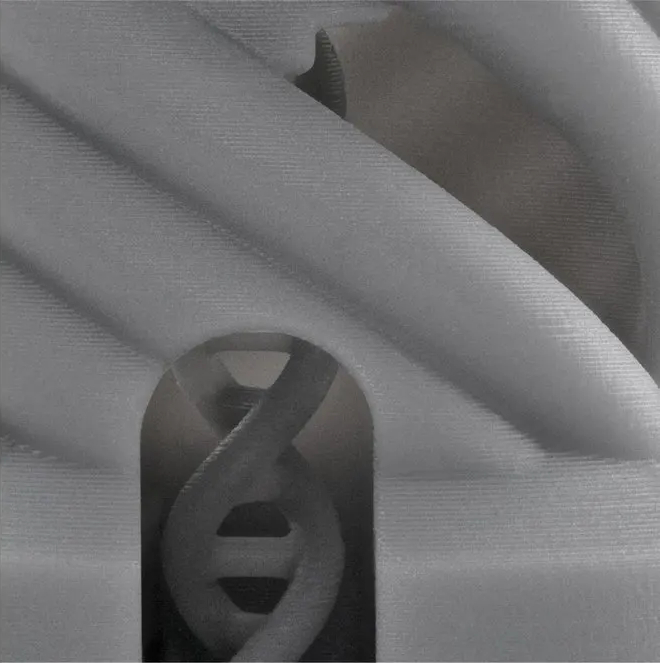
The extruded material is circular in cross-section, which leaves very narrow crevices in between layers with a depth directly proportional to layer height. It is recommended in any case to print at the lowest feasible layer height for food safe parts.
Consequently, the main challenge with FDM parts is avoiding the buildup of bacteria. To be truly food safe in the long term, an FDM 3D print needs to have a smooth surface. Chemical smoothing with solvents like acetone, d-Limonene, or ethyl acetate removes many of the irregularities of the print resulting in a smooth, glossy appearance. However, applying a subsequent food-safe coating is still highly recommended.
Food grade filaments do not contain any composite particles so will not wear down the nozzle into the print. Nevertheless, avoid brass nozzles that contain lead and use a dedicated stainless steel nozzle instead for all food contact items.
Always check the compatibility of your 3D printer’s components with the filament. For example, PEI is a material that is FDA compliant and offers great mechanical benefits but needs to be processed at over 300 °C, which requires a specific printer solution.
The most common questions around FDM food safety concern two popular materials. Is PLA food safe? Is ABS food safe? The answer is, it depends.
Food safe 3D printing filaments include PLA, PP, co-polyester, PET, PET-G, HIPS, and nylon-6, as well as some brands of ABS, ASA, and PEI. Having to run parts through the dishwasher rules out PET, nylon, and PLA because these plastics soften and distort around 60–70 °C. For applications involving hot liquids, co-polyester, High Temperature PLA or PEI are most suited.
While not reflected in the regulations, some studies suspect that polystyrene may leach styrenes, co-polyesters might cause health concerns and that food-grade FDM filaments might lose their safe status due to oxidation and thermal degradation from the printing process.
| FILAMENT | MNFG BRAND | FDA RECOMMENDATIONS | SMOOTHABLE | DISHWASHER SAFE |
|---|---|---|---|---|
| ABS | Adwire PRO | Approved | Yes, acetone | Yes |
| Innofil3D | Approved except red, orange, and pink | Yes, acetone | Yes | |
| ASA | Innofil3D | NA | Yes | |
| Bendlay | Orbi-Tech | NA | Yes, brake cleaner | No |
| Biocompound | Extrudr GreenTEC | NA | ||
| Co-Polyester | Colorfabb XT | Approved | No | Yes |
| HIPS | Easyfil | Compliant | Yes, d-limonene | Yes |
| Fillamentum | NA | Yes, d-limonene | Yes | |
| InnoFil3D | Approved | Yes, d-limonene | Yes | |
| Nylon | Taulman Nylon 680 | Compliant | No | |
| PEI | ULTEM® 1000 | Compliant | Yes | |
| PET | InnoPet EPR | Approved except red and orange | Yes, ethyl acetate | No |
| Refil | Approved | Yes, ethyl acetate | No | |
| Taulman T-Glase | Approved | Yes, ethyl acetate | No | |
| Verbatim | Compliant | Yes, ethyl acetate | No | |
| PET-G | Extrudr MF | NA | Yes, ethyl acetate | No |
| HDGlass | Approved | Yes, ethyl acetate | No | |
| PLA | Filaments.ca TrueFS | Approved | No | No |
| Fillamentum | NA | No | No | |
| Innofil3D | Approved except red, orange, pink, apricot skin, grey, and magenta | No | No | |
| Copper3D PLActive Antibacterial | Approved | No | No | |
| Makergeeks | Approved | No | No | |
| Purement Antibacterial | Approved | No | No | |
| PLA-HT | Makergeeks Raptor | Approved | No | Yes |
| Makergeeks Raptor | Approved | No | Yes | |
| PP | Centaur | Compliant | No | Yes |
| InnoFil3D | Approved | No | Yes | |
| Nunus | Compliant | No | Yes | |
| Verbatim | Compliant | No | Yes | |
| SBS | Filamentarno | NA | Yes, d-limonene | Yes |
Selective Laser Sintering is a 3D printing process that use a high-powered laser to fuse small particles of polymer powder. The most common material for laser sintering is nylon, a popular engineering thermoplastic with excellent mechanical properties.
While some SLS powders are graded food safe, the particles on the surface of printed parts might not fuse completely, resulting in parts that are inherently porous and do not deal well with moisture and mold growth. Even though the nylon 12 powder can be steam cleaned in an autoclave, it is best to coat SLS parts with food-safe coatings to seal their surface.
Food safety with 3D printing is not a simple matter that will boil down to a clear yes or no answer. Producing 3D printed parts for food contact items requires careful consideration of the risks depending on their intended use.
For further information on food safety and 3D printing, we recommend reading the following: